
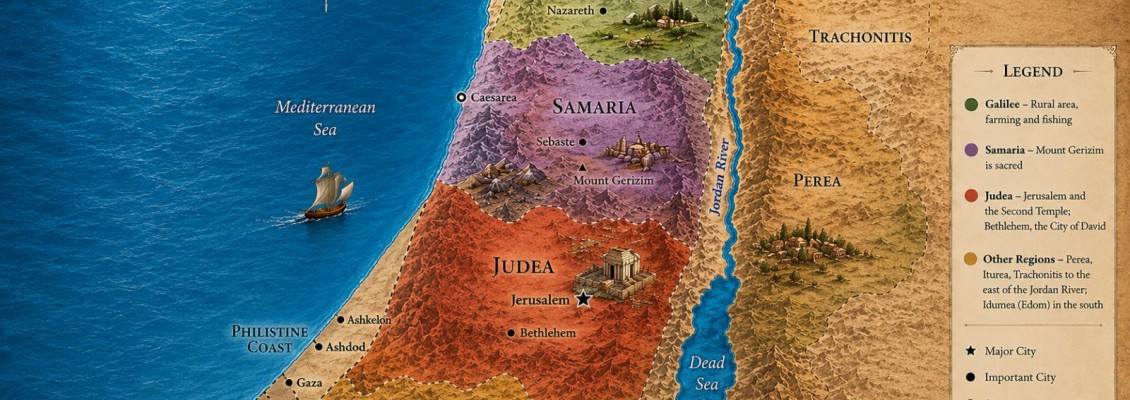
THE REGION OF PALESTINE IN THE TIME OF JESUS
At the time Jesus (peace be upon him) was born, Palestine was under Roman rule. Jewish religious life centered around the Second Temple in Jerusalem. During this period, messianic expectations ran high within Jewish society. Therefore, analyzing the political and religious landscape of the region is very important for understanding the message of Jesus.
At that time, the name Palestine referred to the Mediterranean coastal area, around present-day Gaza, Ashdod, and Ashkelon, where the Philistines lived. After the Bar Kokhba Revolt, the Roman Emperor Hadrian officially named the province Syria Palaestina. He did not create a completely new name. Instead, he adopted a term that had already been in use and made it the official name of the province.
The region was divided into several smaller regions. From north to south, there were three main regions. Galilee was in the far north, mostly a rural area where people lived through farming and fishing. The town of Nazareth was also located here. South of Galilee was Samaria, where cities such as Sebaste and Caesarea showed strong Roman and Greek influence. The Samaritans were related to the Jews in both history and religion, but Jerusalem was not the only religious center for them. Instead, they considered Mount Gerizim sacred. Differences between the Jews and the Samaritans caused tension.
Further south was Judea, where Jerusalem and the Second Temple were located. Bethlehem was about 8–10 kilometers south of Jerusalem. It was known as the City of David. In the Old Testament, Micah 5:2 states that a ruler for Israel would come from Bethlehem. Because of this belief, Bethlehem became an important place in Jewish expectations about the Messiah.
On the east-west axis, the Jordan River formed a natural border in the region. To the east of the river were Perea, Iturea, and Trachonitis. In the south was the region of Idumea, also called Edom.
From the birth of Jesus to the crucifixion attempt, Palestine remained under the ultimate authority of the Roman Empire. Rome’s primary goals were to secure regular tax revenues and maintain public order. To achieve this, Rome did not impose a uniform administration. Instead, it developed flexible models suited to local conditions. Tetrarchy was one of the examples of this system, which divided the country into several regions, each ruled by local leaders who answered Rome.
At the time of Jesus’ birth, Herod the Great ruled the region as a king loyal to Rome. He controlled Judea, Samaria, and Galilee. After his death around 4 BCE, his kingdom was divided among his sons with Roman approval. [1]
Herod Antipas became ruler of Galilee and Perea. [2] Philip governed Iturea and Trachonitis in the northeast. Archelaus ruled Judea, Samaria, and Idumea. However, Archelaus removed from power because of his poor leadership. Since Jerusalem and the Temple were politically sensitive, Rome decided to govern Judea directly.
This direct imperial oversight introduced Roman governors (prefects or procurators) into the region. Pontius Pilate was one of these administrators. He governed Judea from 26 to 36 CE and represented the Roman authority during the trial of Jesus. [3]
First-century Palestine displayed rich linguistic diversity. Aramaic was the most widely spoken language in daily life, especially in villages and rural areas. Hebrew was mainly used in worship and sacred texts. Greek was important in trade and in Hellenistic cities, while Latin was used primarily by the Roman army and administration.
The Second Temple was the center of spiritual and communal life. Sacrificial rituals, priestly ordinances and pilgrim festivals like Passover (Pesach) all revolved around the Temple complex. However, Second Temple Judaism was not a monolithic structure. It was divided into several distinct socio-religious factions:
The Sadducees, who represented the wealthy priestly aristocracy, they controlled the Temple, supported the political status quo, and accepted only the written Law of Moses. That is why, they rejected oral traditions as well as the belief in resurrection and the afterlife. In contrast, the Pharisees held great influence over ordinary people and daily religious life. They defended authenticity of both the written Torah and oral traditions, and firmly believed in angels and the resurrection of the dead.
The Essenes were a monastic movement that emphasized ritual purity and apocalyptic expectations; the famous Dead Sea Scrolls are widely connected to them. Finally, the Zealots formed a radical nationalistic movement. They believed that armed resistance against Roman rule was a religious duty, and expected a military leader who would liberate their land.
Because of these different religious understandings, the expectations of the Messiah were also different. Some people hoped for a political and military king who would drive the Romans out of the land. Others waited for a prophet who would bring moral and spiritual change. For this reason, the message of Jesus gave hope to some people, while others saw it as a dangerous threat.
This division and the nature of Jesus’s purpose are reflected in the Qur’an. According to it, he was the Messiah who came not as a political ruler, but as a prophet calling people back to faith, wisdom, and obedience to Allah:
When Jesus came with clear proofs, he said: ‘I have come to you with wisdom and to make clear to you some of the matters over which you differ. So fear Allah and obey me. Surely Allah is my Lord and your Lord, so worship Him alone. This is the straight path. [The Qur’an 43:63-64]
Despite the clear proofs Jesus brought, the complex socio-political environment of the period caused many people to reject his message, while a sincere group stood by his side and supported his mission:
“O you who have believed! be Allah’s helpers, as Jesus, son of Mary, said to the disciples: “Who are my helpers for Allah?” The disciples had responded by saying: “We are Allah’s helpers.” Some of the Children of Israel believed and some disbelieved: We supported the believers against their enemy and they became dominant.” [The Qur’an 61:14]
[1] Because this date falls a few years before the traditional beginning of the Common Era, modern historical research places the birth of Jesus Christ most likely between 6 and 4 BC.
[2] The "Herod" mentioned in relation to Jesus’ adulthood is most often Antipas.
[3] This explains the dual authority seen during Jesus’ trial. According to The Gospel of Luke, since Jesus was a Galilean, the Roman governor Pilate sent him to Herod Antipas, the ruler of Galilee.
Leave a Comment